




The UK State of the Climate report 2024
[edit] Introducing 10 years of a changing climate
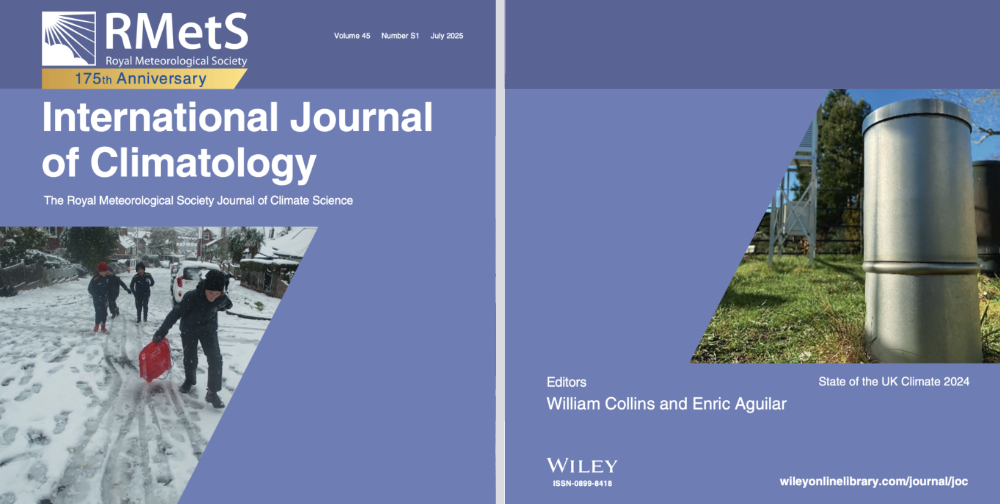
On 14 July, 2025 the UK State of the Climate report 2024 was published as a special issue of the International Journal of Climatology, which is the Royal Meteorological Society journal of climate science and provides a review of the climate and significant meteorological events of the year.
The report, published since 2015, is now the 11th year, and warns that the climate is continuing to change, with recent decades becoming warmer, wetter, and sunnier, changes that align with global trends in near-surface air temperature increases over land.
The executive summary of the report covers a number of different aspects that are outlined in brief below, for further information, data, statistics and graphical representations refer to the original document.
[edit] Temperature
The UK has experienced a steady warming since the 1980s, with 2024 being the fourth warmest year on record. The last decade (2015–2024) was 1.24°C warmer than 1961–1990. Record-breaking monthly temperatures are becoming common, with 2024 featuring the warmest May and spring ever recorded. Temperature anomalies exceeding 5°C, 8°C, and 10°C above the 1961–1990 average have significantly increased, especially in the most recent decade.
[edit] Air and Ground Frost
Air and ground frosts have declined by about 25% since the 1980s. The 2015–2024 decade had significantly fewer frost days compared to earlier periods. In 2024, air frost days were the second lowest, and ground frost days were the lowest since records began.
[edit] Indices for Energy Demand and Plant Growth
Heating degree days have decreased steadily, while growing and cooling degree days have increased. Compared to 1961–1990, the last decade saw 14% fewer heating days and 21% more growing days. Cooling degree days have roughly doubled.
[edit] Near-Coast Sea-Surface Temperature (SST)
Coastal waters have warmed steadily, with the most recent decade being 0.9°C warmer than 1961–1990. Five of the ten warmest years for UK SST have occurred since 2015, with 2024 ranking sixth.
[edit] Rainfall
The UK has become wetter since the 1980s, especially in winter. The last decade was 10% wetter than 1961–1990. Winter rainfall has increased more significantly than summer, with six of the ten wettest winters occurring this century. In 2024, the October–March period was the wettest on record.
[edit] Snow
Snowfall has declined since the 1960s, with fewer widespread and severe snow events. Notable recent snow occurred in November 2024, the most significant for that month since 2010.
[edit] Sunshine
Since the 1980s, sunshine hours have increased, particularly in winter and spring. The 2015–2024 decade was 8% sunnier than 1961–1990. However, 2024 was unusually dull, breaking the increasing sunshine trend.
[edit] Wind
There is no clear evidence of a long-term increase in UK windiness. Wind speeds have declined since 1969. Although nine named storms occurred in 2024, long-term gust speeds have reduced compared to earlier decades.
[edit] Extremes and Significant Weather
Extreme weather, such as floods and storms, continues to be a regular feature. Records include all-time high monthly temperatures in five different months during the last decade. Heavy rainfall in late 2024 caused record flooding, especially in Oxford and South Wales.
[edit] Sea-Level Rise
UK sea levels have risen about 19.5 cm since 1901, with acceleration in recent decades. Sea levels have increased 13.4 cm since 1993, outpacing global averages. The highest sea levels were associated with storms in 2024, prompting 11 Thames Barrier closures.
[edit] Phenology
The study of cyclic and seasonal natural phenomena, in relation to climate and plant and animal life. Nature is responding to climate change with earlier springs and longer growing seasons. In 2024, many spring events occurred earlier than average, while tree leaf-fall dates were slightly advanced due to mild summer and autumn conditions.
[edit] Related articles on Designing Buildings
Featured articles
Check out some of the best features and news from Designing Buildings as well as key stories from around the web.

The Building Safety Regulator announces a call for evidence.

Government approach could undermine delivery and regeneration.
World's first mass timber data centre.

The overlooked environmental aspect of data centre development.
Introduction to radon awareness

New technical information sheet published by CIOB.

Updated supplier guide can help electrical contractors engage with NHP.

CIAT confirm the winners of the 2026 architectural technology awards.

Government launches a one stop shop for flood preparedness.

Sir Edwin Lutyens: Britain's greatest architect? Book review.

CIOB publishes free template to help assess and manage risks.
ECA's reflections on Party Conference season

Burnham wants to be confident of winning before asking for a fresh mandate.
New Chief Construction and Scientific Adviser

Sergio Cavalaro, Professor of Infrastructure Systems at Loughborough University.
Building safety levy for England

CIAT publish estimator tool for members.